

Soldering temperature
- Thread starter AtariYinzer
- Start date
You are using an out of date browser. It may not display this or other websites correctly.
You should upgrade or use an alternative browser.
You should upgrade or use an alternative browser.


Very cute. Where's the drawing showing a cap exploding from too much hot air? :-D

Even more consistent than exploding though is the melting of the base. With hot air, you're melting the poor guy's fanny!Very cute. Where's the drawing showing a cap exploding from too much hot air? :-D


On topic: I desolder through-holes at 350-360, with added flux and fresh solder, and usually pre-heat the area with hot air at ~150. I'm considering buying an old toaster / counter-top oven for pre-heating to get at those ground planes (don't really have a need for a proper pre-heater, just a hobbyist hack after all). Also, I sometimes use a bit of chipquick to help with stubborn old solder at those ground planes.
New components go in at 350 with 60/40, preheating at the ground planes.
Off topic: proud push-n-twister!
New components go in at 350 with 60/40, preheating at the ground planes.
Off topic: proud push-n-twister!

My iron is set at 425C. Never had a need to change it. Gets everything i need done, done. Not a temperature I recommend for everyone as I believe I’m up there in the “wth?!” spectrum.

My FX-888D is set to 370C almost all of the time except for ground plane work where I run it at 420C. I've only recently bought a hot air station so will try to use hot air to assist by preheating the ground planes in future. I like the thin conical tips for fine work but use a bevel or chisel tip for larger stuff. I'm currently using RS Pro 60/40 0.71mm solder wire but I have a variety of others which I should start using because the 0.71mm stuff is a bit thick for what I'm doing just now.
I don't often drag solder as I was taught the one pin at a time technique during a MIL-STD-2000 training course about 20 years ago and have stuck with that ever since. Nothing wrong with drag soldering which is almost certainly quicker when things go well and there aren't too many bridges to rework.
If I remember correctly from the MIL-STD-2000 course, the reason they advocate a single pin approach for SMD soldering of ICs is to ensure the correct quantity of solder is applied. Too little solder is an obvious issue but too much is a more subtle problem and can make the pin too rigid. The pins are designed to flex with thermal expansion and vibration, and if the solder goes too far up the leg then it concentrates that thermal stress on a smaller area of the pin which can cause early fracture. Of course this is more of an issue in harsh environments (eg. military & space) where extended thermal ranges and vibration are more likely. Anyway, what I always try to do is create a nice fillet of solder around the "foot" of the pin which contacts the pad but avoid the solder spilling over the top of the foot and especially avoiding it moving up the "ankle". YMMV
One thing to note is that erosion of soldering tips is much higher once you get up towards and beyond 400C, especially if you don't keep the tips tinned when sitting dormant.
Re the push and twist cap removal technique, I've only used it on one SE/30 board so far but it worked a treat.
Hi.If you need a soldering "iron" hotter than 350°C, then something is probably wrong. It's too easy to overheat sensitive components when you go to 400°C with an iron (especially solid Tantalum capacitors). Some people do it and have no issues, but 350°C is a good rule of thumb to stick to.
I realize ground planes act as heatsinks, but that is why preheating a board with either heat gun or a hot air station often helps. I myself only recently acquired a hot air station thanks to a kind recommendation from @Kai Robinson. I believe @Branchus at one point told me he goes to 400°C and beyond with his hot air station, and I believe it too because I am not very good at desoldering components, even with small tips, on my hot air station when set to only 350°C. But even if you use a hot air station at 350°C, you still have to be very, very careful not to melt plastics. That's why I still am mostly using irons. I don't have many accidental meltings with soldering irons..
It took a while to get through the registration process, but I did it. Do you know of anyone in the NYC metro area how might be able to assist me? Thanks.
TPOPE
@Mac84 is based in New Jersey. Not sure if he has time or desire, but he's quite skilled at testing and repair.Hi.
It took a while to get through the registration process, but I did it. Do you know of anyone in the NYC metro area how might be able to assist me? Thanks.
TPOPE

Hello, I'm located in New Jersey. What do you need assistance with? Feel free to message me directly if you have any questions, etc.Hi.
It took a while to get through the registration process, but I did it. Do you know of anyone in the NYC metro area how might be able to assist me? Thanks.
TPOPE
Hello. I transplanted a Seasonic 300 into a SE30 PSU and wanted a professional check out before.power up. I have a need for so much power (fans, lights, and future appliances) and don't want any circuits clipped. Of course. If I have made a mistake I would appreciate a correction. Also I don't have the tools you do so if my work seems rough to you feel free to make any safety I.provements. Peace.Hello, I'm located in New Jersey. What do you need assistance with? Feel free to message me directly if you have any questions, etc.
TPOPE
If you have a volt meter, you should check the voltages at the white (semi-transparent) 10-pin connector you attached to it, as shown in the photo below. Because if the voltages you measure there are all correct, and if the Grounds are all correct, then you really don't have anything to worry about when you attach it to the Mac.I transplanted a Seasonic 300 into a SE30 PSU and wanted a professional check out before.power up.
Ok, Thanks.If you have a volt meter, you should check the voltages at the white (semi-transparent) 10-pin connector you attached to it, as shown in the photo below. Because if the voltages you measure there are all correct, and if the Grounds are all correct, then you really don't have anything to worry about when you attach it to the Mac.
View attachment 1738
View attachment 1739

I'm testing my hot air station on an old Panasonic DVD player board before unleashing it on my SE/30. I tried the push/twist method and pulled up a few pads before I gave up. I set the hot air at 370 c and removed several surface mount caps. I had never done surface mounts before, that's why I tested on an old DVD player. I lost a few pads before I discovered that if I held the cap with tweezers and pulled up slightly until the board was almost lifted, as soon as the solder melted the board dropped under its own weight and this released the cap from the solder mount. I held the nozzle vertically straight and moved back and forth slowly from one pad to the next. I did the whole SE/30 board and didn't lose any pads.
meanwhile, on the DVD board I found this thing, I don't know what it is but it looks pretty cool.
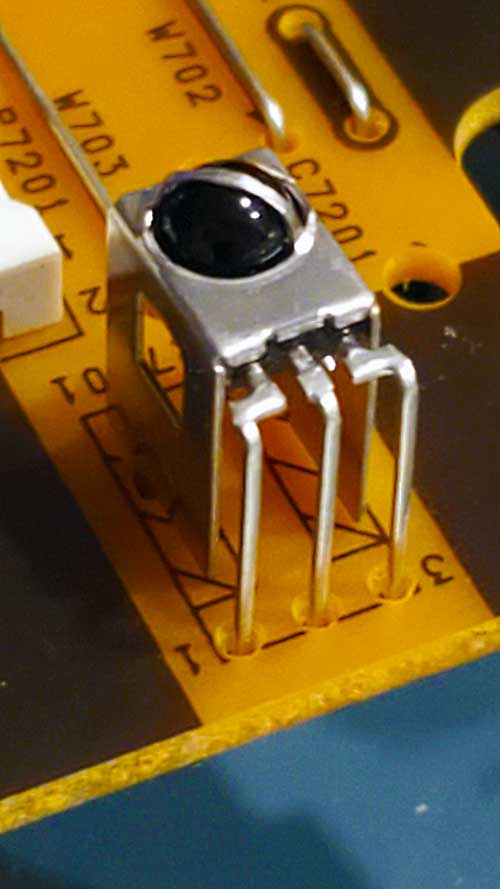
meanwhile, on the DVD board I found this thing, I don't know what it is but it looks pretty cool.
meanwhile, on the DVD board I found this thing, I don't know what it is but it looks pretty cool.
Looks like the IR photodiode for the remote.
Public Service Announcement: Remember to take the protective cap OFF of your soldering iron before turning it on!
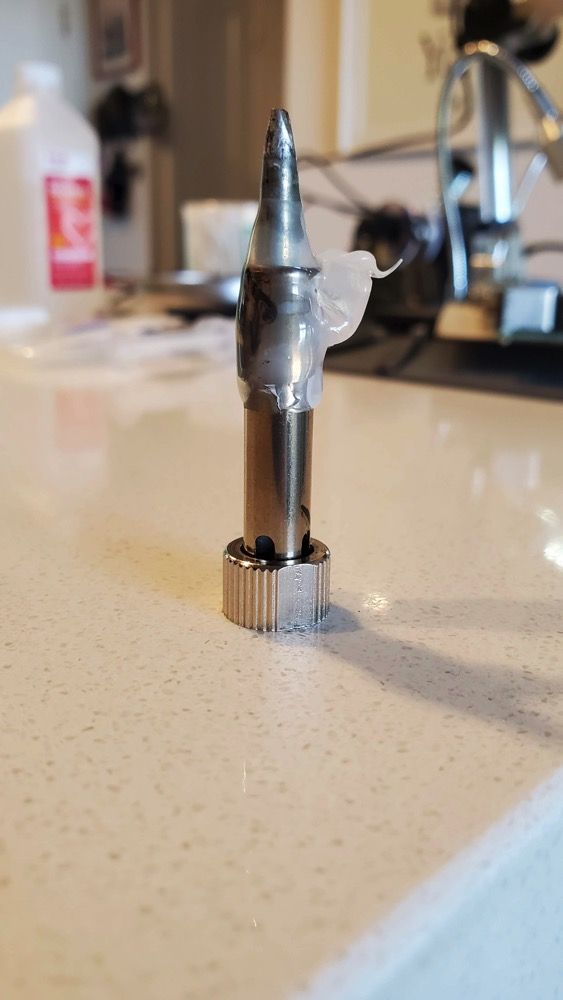
Set it to "self clean" outside for an hour. It'll be fine.Public Service Announcement: Remember to take the protective cap OFF of your soldering iron before turning it on!
View attachment 3475
And when soldering while using magnification keep in mind that your depth perception may be hosed, unless you like the sound of your nose grease sizzling.Public Service Announcement: Remember to take the protective cap OFF of your soldering iron before turning it on!
Just call me Stripes.