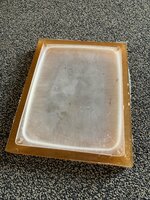
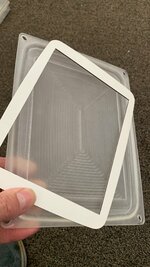
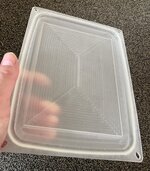
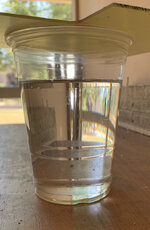
The concept to use and fill the original CRT with resin did optically work very well.
(No internal reflections or whasoever)
Setback I could only create one piece,
and is still a lot of work.
As Ive drawn the CRT glass section a while back, the idea came to me to recreate the complete CRT frontsection in optical glassclear resin.
That would involve creating a full mould.
This is a lot of work…..
Combining the CRT glass with a supportmould will create an accurate CRT shape and save time in the process.
About five weeks ago ive bought two packages of one liter UV resistant clear resin sets (for another project)
The first bottle only had a 100grams of resin left was ok, mixed it up and poured that in the mould.
Opening the new bottle showed it did crystallize…..or something like that….so this is the end for the joy of today
Hi, Thanks!
Hope it works out ok….
This stuff is pricy.
For the making of the master mould,
check post 63.
As I used the original CRT glass in the master, the curvature cant be far off.
Less than 1% as I understand
1% shrinkage……Well, this true.
Unfortunately the material is thicker in the middle and so additional causes a slight surface deformation, aswell causing a light bend.
On itself not a real problem, only that I actually need a higher mould.
This way I can cut a slice off the lens and flatten it out.
Those processes can indeed be applied…
but its very time consuming.
The frontside and the material as a whole is pretty smooth (like the original) and crystal clear.
Its the backside that needs the additional work.
Ive roughly sanded it flat for now.
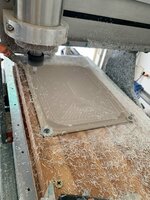
My aim is to cut out a chunk,
to get the display as far forward as possible.
More next!
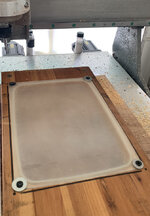
Cutting a flat surface and border for the display went well.
The display gets mounted to the
(white-later black) border with double sided tape.
The subassembly then fits the curved glass.
This way it can be disassembled if needed.
Now some polishing to do……
Following with great interest, best of luck getting this worked out. Wondering if milling a convex back surface for a two part mold might be an approach to try. smoothing and polishing a convex surface is oh so much easier than concave surface work.
Just in case:
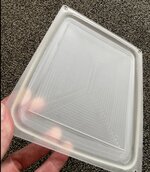
I've got a thread about vacuum forming plexi using the CRT itself as the buck (mold) but was using the plexi scrap I have on hand. Results almost there, excellent, if not perfect. Material needs to be a much thinner sheet to work. There's info about that over at the MLA. Results were amazing, but don't recall offhand who pulled that off or if the process used was vacuum forming or drooping?
Yes. Only the visible section.
The rest should become black.
Vacuum forming is a good solution for many products. Transparent is bit harder to keep the thickness overall about the same.
The trouble with some thermoplastics is that these are mostly realively soft.
And so scratches/damages more quickly.
PLEXIGLAS®- cast resinsheetmaterial is a bit more durable and more scratch resistant.
Thats why ive gone this route/exploration.
Real glass, model pressed is actually the final and only superior solution in this matter. Just like the CRT ….
I was playing at making a 1/8" MacQuarium bubble, so that was the way to go at the time. Affordable LCDs were still a thing of the future in terms of availability/price point.
Something you might want to try is aquarium background adhesive, an optically clear gel for sticking decorative backgrounds on fish tank. It really makes the backgrounds pop compared to just taping the background on. It might make the LCD look shaper by filling the tiny air gap between the panel and the resin piece. I think it's viscous enough that it won't seep anywhere you don't want it and cause damage.