Hardware/software you have that no one talks about.

I've got an OrangePC 620 myself in a 7300, bumped up to a 400MHz K6-II. It's a little wacky with the G4 upgrade, though.
Mine also has a K6-II at 450Mhz. It's neat, but I'm tempted to slot in something less powerful. The GPU on it isn't the best, and a I don't want to be tempted to use software mode because of the beefy CPU. I'm also worries about the weight of the heatsink and the stress on the board. It's probably ok. Probably.
 
  • Like
Reactions: ClassicHasClass
Ok, I have another one … Transoft SCSI-Net.

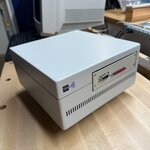
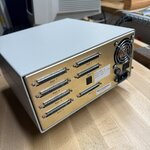
This was a SCSI hub that allowed up to six Macs to share a single SCSI device, usually a hard drive. In the configuration we had at Image Club Graphics (circa 1994 to 1996), each Mac ran client software and had an accelerated SCSI card (something Nubus, like an ATTO Silicon Express) that connect to the SCSI-Net hub via 15 or 20 foot SCSI cables. The hard drive attached to the hub was partitioned into different volumes, primary so out creative team could access different projects saved on each volume.

Using the shared volumes was a bit like version control, where a user would “check out” a volume when working on a given project, giving them read-write access. That volume would be read-only to the other users, until it was “checked in”.

It was way faster than file sharing over ethernet, as it was essentially connecting another SCSI drive to your machine.

There’s a blurb about it in this August 1993 issue of Macworld.

I still have the hub, the comically huge cables, and the master install CD in the collection.
 

Attachments

  • IMG_8077.JPEG
    IMG_8077.JPEG
    243.2 KB · Views: 110
  • IMG_8078.JPEG
    IMG_8078.JPEG
    328.6 KB · Views: 99
QuickShare (1987) was a similar setup that connected the SCSI Port of my SE directly to the QuickShare SCSI Card in my Tandy 1000SX PC. I had 20MB of the PC's 40MB Drive set up as a Macintosh Volume and could transfer shared files Mac<->PC at SCSI speeds. I had a JT-FAX card in the PC and would have customers send me their artwork via FAX, translate the graphics format and use it on the SE production machine in Fontographer with no paper involved.

More details here:
 
Last edited:
Weird SCSI peripherals are the best, aren't they?
Amen to that. Had a run in with one of the know it all "Consultants" that ran NYMUG back in that day. When I said QuickShare's SCSI transfers were faster than Ethernet he insisted 10bT was faster. Explained that 8Mbyte/sec. was much faster than 10Mbit/sec and he came back with the typical consultants "in my experience" retort.

Even at what we now know was closer to 5Mbyte/sec, it'd be 4x faster than 10Mbit without considering the network handshaking overhead. So many folks KNEW SOOOO MUCH back in those days . . . :rolleyes:

Yes, actual Mac SCSI performance was much lower than theoretical, but....

Mac network performance was also much slower than theoretical transfer speeds.
 
I don't have one, but the Mac had a SCSI network controller of some kind. I only learned it existed when the BlueSCSI could emulate it in a way.
 
In terms of software, there is a program I recently discovered called MacPalette II, which allows the ImageWriter II to print color documents from Word, Acrobat Reader, etc.

I have a thread about it on the other forum. Trying to download version 2.5 so it will work properly in OS 9.2.1, but I’m having some problems decompressing the zip file.

In terms of hardware, there is my OrangePC 486 NuBus card, which I still don’t know its model number. I also remain on the lookout for the rare, unobtainium breakout cable, so I can connect my equally rare Apple PC 5.25” drive to.
 
I stopped by Free Geek Minneapolis today. They have a $1 scrap bin for things that are unknown or get tossed aside. I pulled a couple Sony 3.5 floppy drives from that bin over the last month. But today? A very strange 2.5" hard drive with a clear cover on it, with warranty seals still intact. PraireTek Corporation Prairie 240 drive.
Prairie 240 side.jpg

Google says: "The "PrairieTek 240" is a vintage 42.8 MB, 2.5-inch hard drive introduced in the late 1980s by PrairieTek. It is highly sought after by retrocomputing enthusiasts because PrairieTek was the pioneer of the 2.5-inch hard drive. The "clear cover" version is a factory promotional cutaway/prototype unit designed to let engineers and executives see the internal platters and read/write heads in motion."
Prairie 240 top.jpg

Small piece of history for $1.
 
I stopped by Free Geek Minneapolis again today, and dug through the scrap again... well I found another PrairieTek 240 (with the metal cover vs clear)!
Prairie 240 pair.jpg

This one has the Molex power cable and wires tagged. 5V line was broken off, but I can solder that back on.
Prairie 240 power.jpg

Controller board seems to have slight variations in chip numbers, so I am assuming it is the standard 42mb model.
Prairie 240 controllers.jpg

Hopefully I get around to spinning them up soon.
 
Back